Consumer Debt Collection Lawsuits in Washington, DC: Before and After the 2022 Reform
David McClendon • November 13, 2026
Download PDF
Consumer debt collection lawsuits are among the most common civil cases in Washington, DC's courts. For years they followed a familiar pattern: debt buyers filed them by the thousands, most people who were sued never appeared, and judgments were entered on thin documentation.
In 2022, DC set out to change that. It enacted one of the strongest debt collection reforms in the country. Collectors now have to document the debt and prove they own it before filing, show the court evidence before any judgment, and verify the consumer’s address and photograph the service. And if they don’t, they are liable to be sued for each violation. The law took effect in August 2022 and applied in full from January 2023.
The reform took years to win. DC legal-services organizations had pushed for it for a long time. It passed only once the pandemic opened a window, after a court moratorium had already paused most collection lawsuits. DC is the first jurisdiction to adopt nearly the full set of documentation and service requirements that advocates have sought, and other states are watching.
Data scientists at January Advisors examined DC Superior Court small-claims records from January 2017 through June 2026. This is the first analysis of the reform's effect on the DC docket.
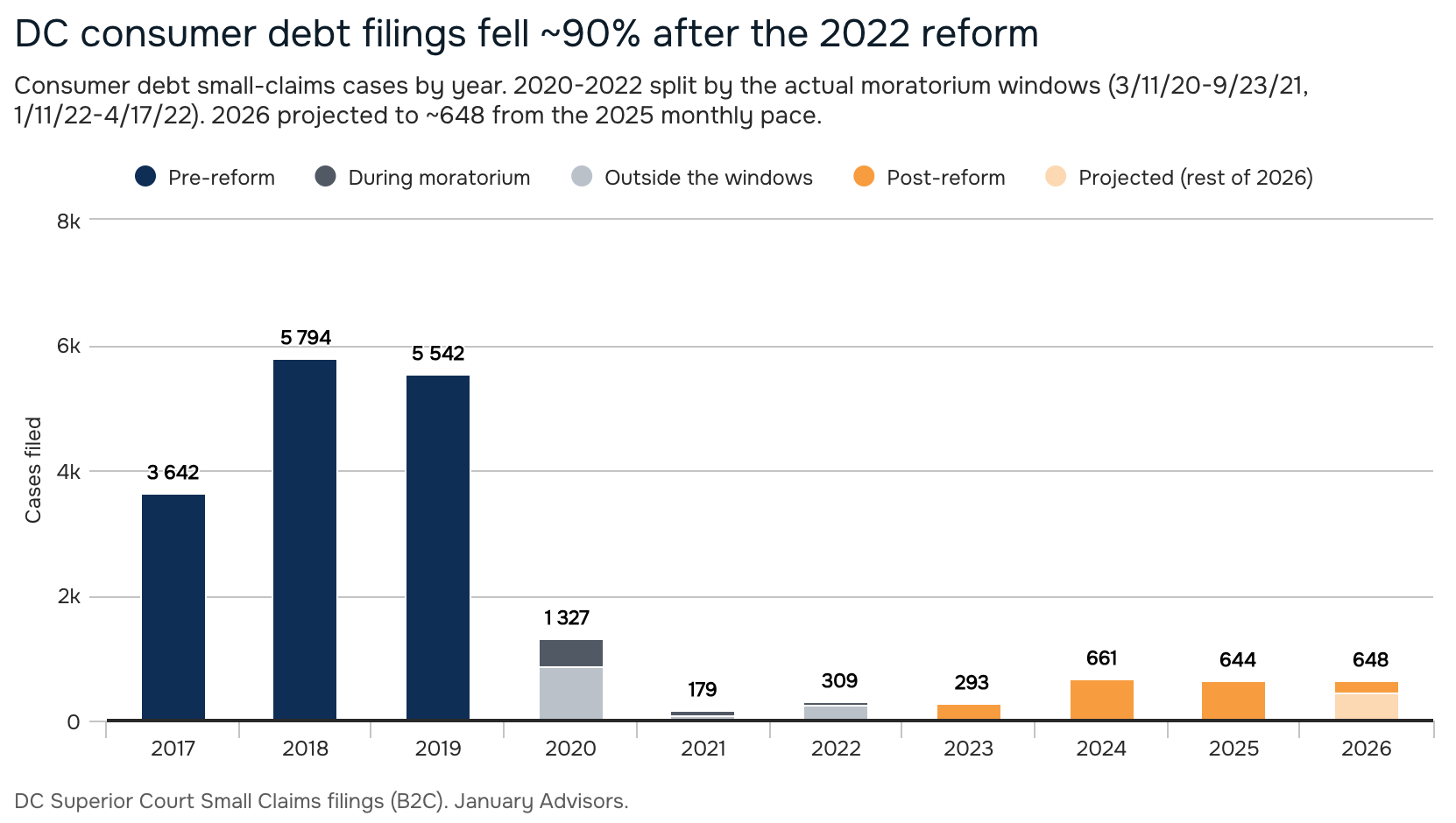
Debt collection filings fell by about 90% after the reform.
DC saw roughly 5,000 business-to-consumer debt lawsuits a year before the reform (2017 through 2019) and about 530 a year after (2023 through 2025). The citywide filing rate dropped from 0.84 to 0.08 cases per 100 adults. A decline this large is unusual. Court-process reforms usually nudge outcomes at the margin; they rarely cut filings by this much.
National debt buyers largely stopped filing lawsuits.
Before the reform, debt buyers brought 63% of DC's consumer debt lawsuits. After, they brought 0.3%. Midland Funding, LVNV Funding, Portfolio Recovery Associates, and Cavalry, the national firms that buy charged-off debt and sue in volume, filed no lawsuits.
The docket also spread out: the ten largest filers accounted for 82% of cases before the reform and 58% after. What remains is local. Credit unions now file about half of all cases, alongside property managers and medical providers.
The pattern fits the reform's documentation rules, which require a debt buyer to produce an authenticated record, affidavit from the original creditor, and an unbroken chain of title. That is expensive and risky for a business model that runs on thin paperwork.
Black neighborhoods saw the biggest relief.
Before the reform, majority-Black neighborhoods were home to 34% of DC's adults but accounted for 62% of its debt filings – 1.8 times their share of the population. The reform cut filing rates by roughly 90% in every neighborhood and income group. Majority-Black neighborhoods stayed more exposed than wealthier, whiter ones, but because debt lawsuits had been so concentrated there, the reform brought them the largest decline, about 4.3 times the drop in majority-white neighborhoods.
Most cases still end without the consumer showing up, but participation edged up.
Debt lawsuits in DC rarely become a contest. Non-service dismissals, cases where the consumer was never served, fell from 48% of disposed cases to 30%. Among cases decided on the merits, default judgments fell from 37% to 29%. Consumer participation stayed low but rose: the share filing an answer went from 0.7% to 2.3%, and counterclaims from 0.1% to 1.0%. Representation rates too stayed low and roughly flat, at about 5%.
Three years in, DC's reform has remade its consumer-debt docket: far fewer lawsuits, almost no national debt buyers, and a modest rise in the defenses consumers raise. As more states consider similar rules, DC offers an early look at how one such reform played out.